- Old Time Tools
- Posts
- A Thanksgiving Story: Thankful for Jack and Woodworking
A Thanksgiving Story: Thankful for Jack and Woodworking
An Unknown Thanksgiving Story

Chad Stanton
November 27, 2025
In partnership with

It’s that time of year again when Americans gather to celebrate Thanksgiving, a day dedicated to reflecting on the blessings in our lives. We express gratitude for family, health, and freedom—and often for the perseverance of the early Pilgrims and the generosity of the Native Americans who aided them.
But how often do we thank the tools? Specifically, the woodworking tools and the humble jack that made their survival possible?
I've always been amazed by the sheer scale of what the early Pilgrims accomplished. They had to clear land, hunt for food, learn new farming methods, survive deadly sickness, and endure heartbreaking loss. Of the 102 Pilgrims who arrived in 1620, nearly half perished in that first brutal winter.
Building a New World with Limited Tools
Arriving on December 16, 1620, the Pilgrims got to work immediately. They started construction on their first "Common House" by Christmas Day to shelter the sick and store vital supplies. Despite the immense difficulty, the colonists managed to build seven dwelling houses and four storehouses by the end of their first year. The following year, they constructed a defensive palisade fence around the entire compound.
Their success was entirely dependent on the limited, yet essential, set of implements they brought with them. While no definitive Mayflower cargo list exists, historians infer the inventory from common provision lists of the era.
The tools they carried—the keys to their survival—were mostly iron and steel instruments for construction, farming, and defense:
Essential Woodworking & Building Tools
Felling & Hewing: Axes (broad axes, felling axes, hatchets) for clearing land and squaring timber, along with large Hand Saws and Whipsaws for cutting planks.
Shaping & Smoothing: The Adze (blade perpendicular to the handle) was used to smooth hewn logs, while Planes (like fore and jointer) leveled wood for furniture and doors.
Joining & Boring: Chisels and Gouges (especially the stout Mortising Chisel) cut joints. Augers and Braces & Bits were used to drill holes for wooden pegs (treenails).
Assembly: Hammers and a critical supply of nails.
Farming and Defense
Farming: Hoes (broad and narrow) for cultivation, and Pickaxes for breaking ground.
Defense: Muskets and fowling pieces for hunting, alongside Swords.
The Tool That Saved America
I plan to cover many of these tools in greater detail in future newsletters, but there is one tool whose importance cannot be overstated—the one upon which the entire future of the colony depended: The Great Iron Screw Jack.
This heavy mechanical device was likely brought for one of two crucial purposes:
Construction: To be used as a lifting jack to raise and position heavy timber beams for the frames of their new Plymouth homes.
Printing: To serve as the massive spindle (the main screw) of a printing press, which Pilgrim leader William Brewster, a former printer, was secretly transporting.
Whatever its intended use, this tool proved to be the most valuable cargo of all.
Before the Pilgrims ever sighted America, the Mayflower was hit by a ferocious Atlantic storm. The severe pitching caused one of the main beams in the mid-section to crack and bow, threatening the ship's entire structural integrity. The sailors feared the vessel would split apart and sink.
In a desperate, brilliant moment, the crew hauled the Great Iron Screw from the hold. They positioned it beneath the broken beam and, by turning the screw, used its immense mechanical force to jack the massive timber back into place. The ship's carpenter then secured the beam with a strong vertical post.

As Governor William Bradford later recorded, the screw was "providentially" brought along. Without the ability to repair the ship, they would have been forced to turn back to England, or the ship might have been lost at sea.
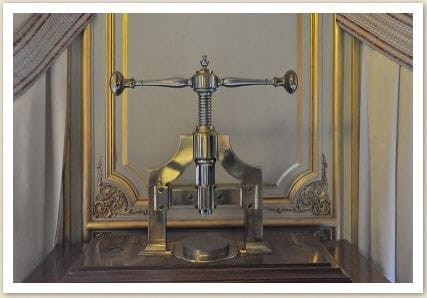
Possibly what the Great Iron Screw Jack could have looked like.
This single piece of iron hardware allowed the Pilgrims to continue their journey and secure their landing in the New World. It’s a powerful reminder that their incredible history—which led to the founding of Harvard College just 16 years later—was built on the strength of their faith, perseverance, and, quite literally, the tools of their trade.
I too am proud and thankful to be a part of the long and rich history of woodworking, and I continue every day to learn and appreciate it all the more. Happy Thanksgiving!
Smart Investors Don’t Guess. They Read The Daily Upside.

Markets are moving faster than ever — but so is the noise. Between clickbait headlines, empty hot takes, and AI-fueled hype cycles, it’s harder than ever to separate what matters from what doesn’t.
That’s where The Daily Upside comes in. Written by former bankers and veteran journalists, it brings sharp, actionable insights on markets, business, and the economy — the stories that actually move money and shape decisions.
That’s why over 1 million readers, including CFOs, portfolio managers, and executives from Wall Street to Main Street, rely on The Daily Upside to cut through the noise.
No fluff. No filler. Just clarity that helps you stay ahead.
Reply